
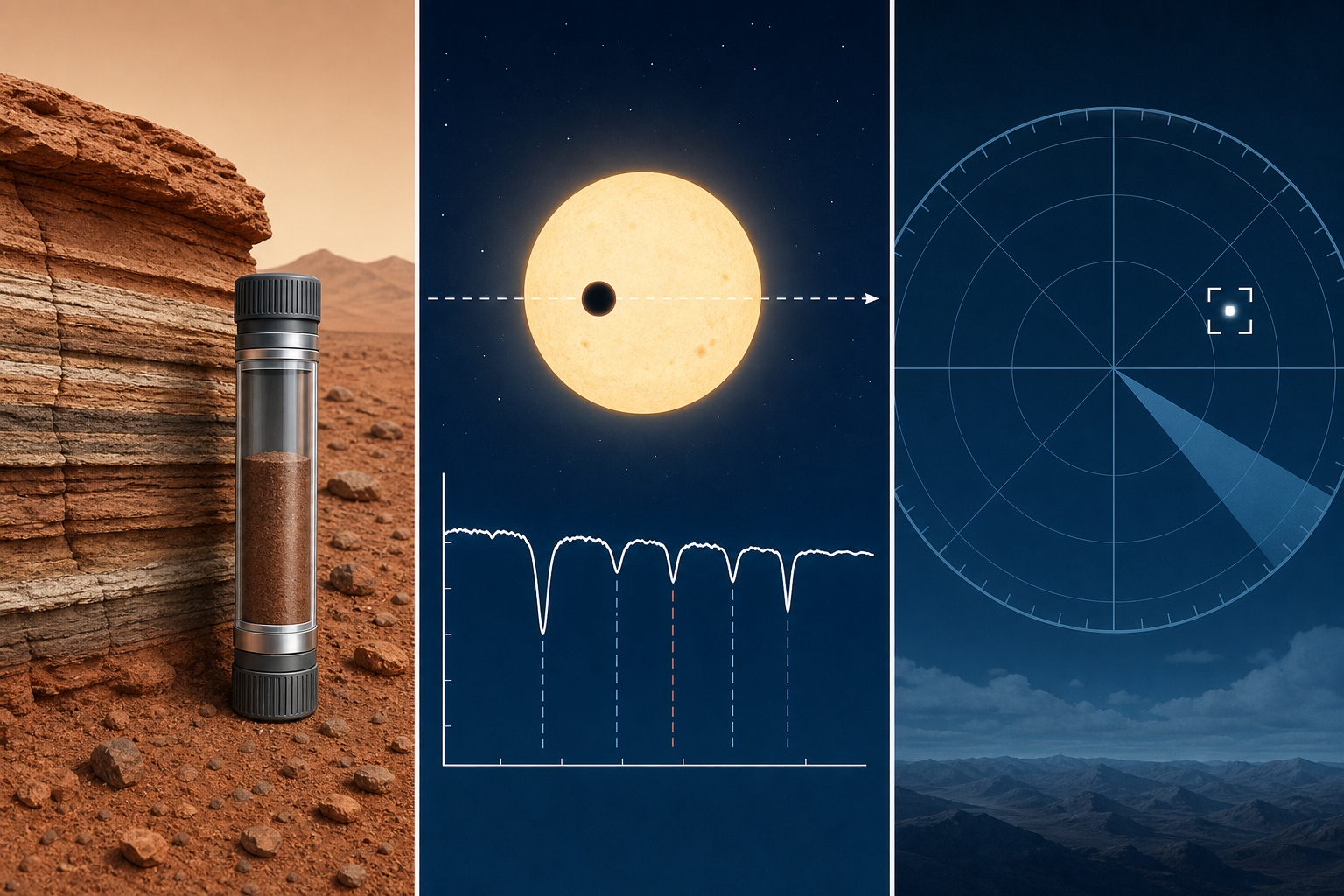
The overview cites Perseverance’s Sapphire Canyon core, disputed sulphur-gas signals and unresolved sightings, but this report did not independently verify the underlying studies or records.
A Space Daily overview published September 1 says nearly seven decades of modern searching have produced no observation establishing extraterrestrial life or technology. It examines a potentially significant Martian rock, contested atmospheric signals from K2-18 b and UAP reports, saying none is a confirmed biological or technological detection.
Its central distinction is between an unresolved observation and a conclusion about its cause: potential biosignatures, statistical preferences for molecules and unidentified objects each leave work to do.
A promising Mars rock still needs laboratory tests
- The overview calls the Sapphire Canyon core, drilled by Perseverance from Cheyava Falls in Jezero Crater in July 2024, its most tangible example. It describes an ancient river-valley setting with organic carbon, sulphur, oxidised iron, phosphorus and small reaction features called “leopard spots.”
- Rover observations were consistent with iron-rich minerals including vivianite and greigite, where sediment and organic matter had reacted. Comparable Earth reactions can be associated with microbial activity, making this a potential biosignature, the article says.
- But such minerals can form without biology through heat, acidity or organic-compound reactions. Without the microscopy, isotope analysis and controlled experiments possible on a returned sample, Cheyava Falls remains a geological pattern in a potentially habitable ancient setting—not a demonstrated organism, fossil or metabolism.
The K2-18 b signal remains disputed
- K2-18 b, about 124 light-years away, is studied while crossing its star. Possible atmospheric gases are inferred from wavelength-dependent changes in starlight, not sampled directly.
- The article recounts analyses reporting methane and, less confidently, possible dimethyl sulphide (DMS) and dimethyl disulphide. DMS drew attention for its close association with marine microbes in Earth’s atmosphere, but that does not make it exclusive evidence of life elsewhere, it says.
- Independent work recovered methane but found no reliable statistical support for DMS, the overview says. Modelling choices, instrumental effects and included molecules can substantially alter interpretations; the immediate question is whether sulphur-bearing gases are present at all.
- Even a firm molecular detection would not demonstrate an ocean, habitable surface or biology. A stronger case would require compatible repeat spectra, credible environmental models and evidence that abiotic chemistry could not plausibly sustain the gases, it says.
Unresolved UAP reports do not identify an origin
The overview treats UAP reports separately: observations in or near Earth’s environment often rely on witness accounts or defence instruments rather than controlled scientific observation. “Unidentified” denotes an unresolved observation, not an object’s origin.
It cites 12,618 Project Blue Book sightings from 1947 to 1969, including 701 unidentified, and 1,870 All-domain Anomaly Resolution Office reports as of May 30, 2025. These different programmes do not form a continuous statistical series, it cautions.
AARO had resolved hundreds of cases as ordinary objects or events—balloons, satellites, birds, aircraft, drones, a rocket launch and a jet pack. Satellite flares identified through three-dimensional modelling illustrate how additional data and geometry can yield a conventional explanation.
Unresolved reports may raise aviation-safety, surveillance, drone or sensor-performance questions, but their number alone cannot establish extraterrestrial craft.
Editorial analysis
What would make the evidence stronger
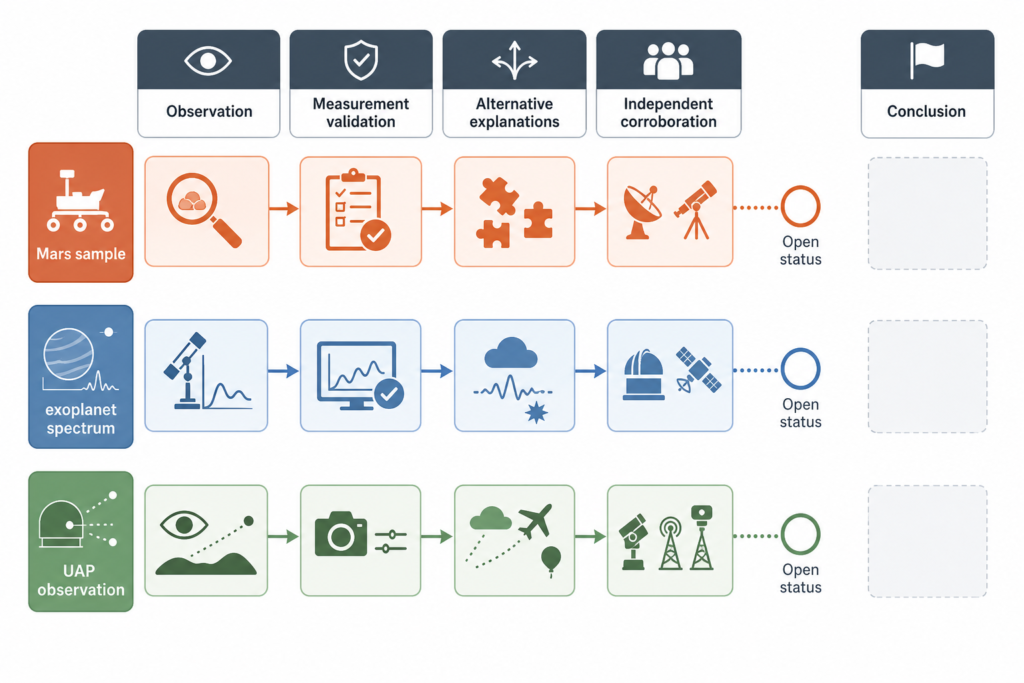
Each category has a different bottleneck: Mars offers a physical but distant sample; K2-18 b is read through faint spectral signals; and UAP cases may lack calibrated, repeatable measurements to reconstruct an event.
For Mars, the article calls for agreement among microscopic structures, isotope patterns, organic chemistry and geological context, plus contamination controls if samples reach Earth. For an exoplanet, it calls for repeat observations across instruments and models excluding plausible abiotic chemistry. For a technological signal or UAP case, it identifies provenance, repeatability, interference checks, calibrated multi-sensor data, precise geometry and a documented chain of custody.
These are verification thresholds, not predictions that decisive evidence will emerge.
What this assessment does not establish
- No newly released mission data, peer-reviewed result or primary agency document was included to independently establish the Mars, exoplanet or UAP claims summarized by Space Daily. This report relies on the overview rather than independently confirming every underlying study or government record.
- The absence of a confirmed detection does not show life is absent elsewhere. Searches cover limited places, times, frequencies, methods and sensitivities; null results constrain particular possibilities rather than settle life’s prevalence in the universe, according to the article.
Sources
Related coverage
- Roscommon Herald Reports RTÉ Documentary on Boyle Lights and Lough Key Experiment
- DeFi Rate puts odds of qualifying U.S. extraterrestrial declaration by 2026 at 4.5%
- Recovered World Cup guide offers no evidence for ‘Ufo Files’ title
- Reported Gallup Poll Finds 78% Think U.S. Withholds UFO Information
- USA Herald calls for wider testing of reported luminous UAP lights
Follow the story

Post Links Grusch and Elizondo to Roswell-Era Crash Retrieval Claims
Its proposed 70-year narrative relies on purported MJ-12 files, Corso’s accounts and retrospective testimony; the material provides no authenticated records establishing a single…

Kevin Campbell Describes Unidentified Objects on MQ-9 Feeds Over East Asia
In a Sept. 3 Americans for Safe Aerospace interview, Campbell said he saw several objects while monitoring military video feeds in 2023–24. A…

Pentagon Notice Proposes Sole-Source Subscription to Private UAP Archive
Washington Headquarters Services says AARO would receive digital access to proprietary historical data, metadata and analysis from a New Mexico records center; the…