
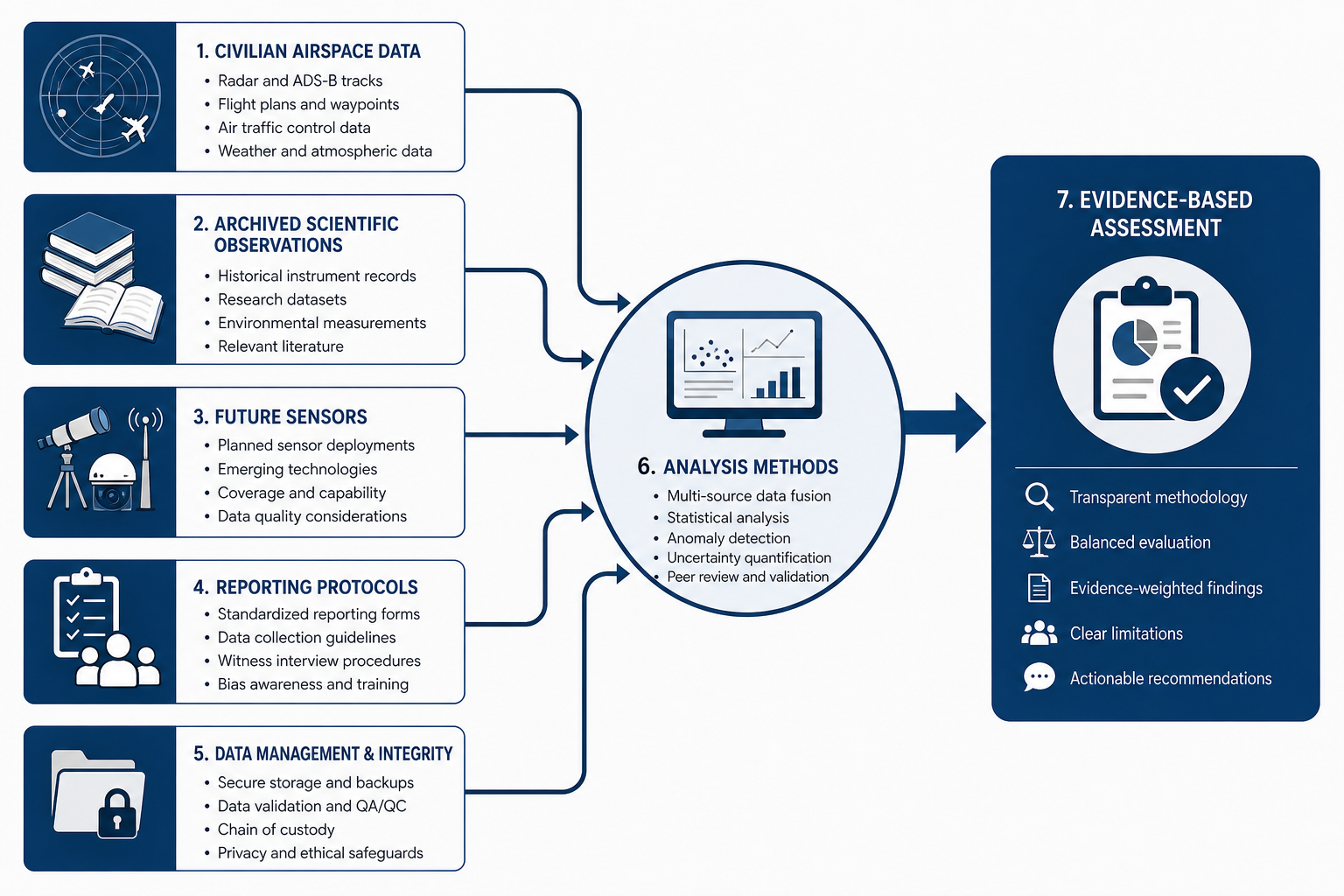
NASA’s public record shows the independent study examined existing and future data, reporting protocols and civilian-airspace information. The resource page does not assess specific incidents or establish an explanation for UAP.
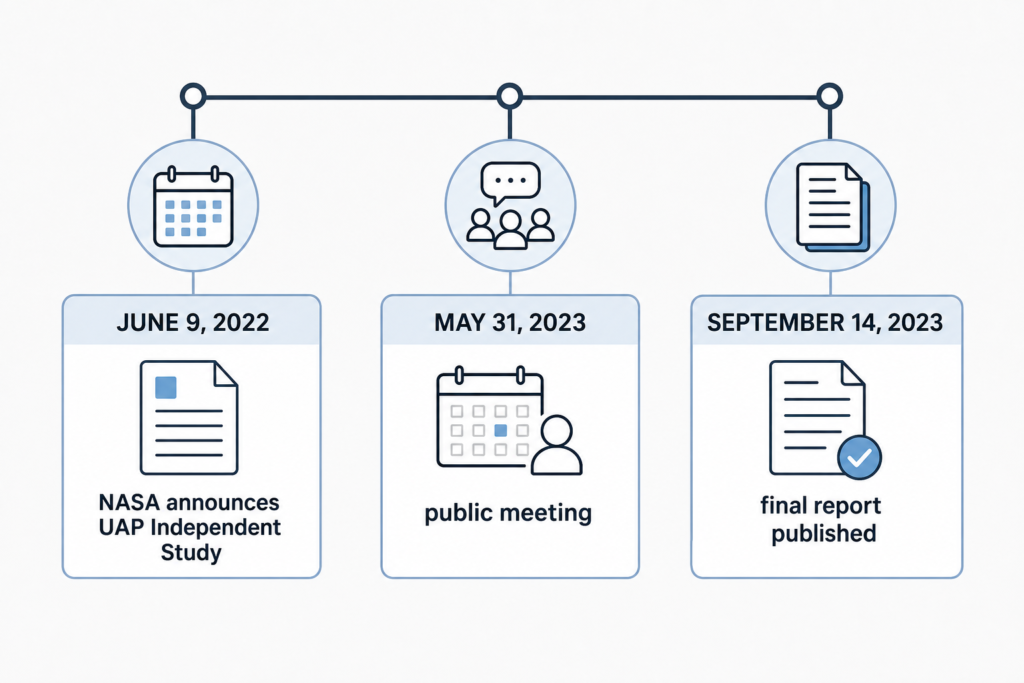
NASA’s UAP resource page describes an independent study focused on scientific methods, available data and future data collection, rather than confirming a particular explanation for unidentified observations. NASA says it announced the study on June 9, 2022 and published the team’s final report on September 14, 2023. The agency defines UAPs as observations of events in the sky that cannot be identified as aircraft or known natural phenomena.
That definition describes an unresolved classification, not an established origin or technology. The page links the study’s statement of task, terms of reference, public-meeting material, briefings and final report, documenting an advisory effort on organizing civilian scientific inquiry rather than an operational investigation of one incident.
NASA asked how better data could narrow uncertainty
- NASA says the study was tasked with identifying scientific data already collected and archived by NASA, other civilian government bodies, nonprofit organizations and companies that could be synthesized and analyzed to inform understanding of UAP nature and origins. It was also asked what additional data NASA could collect in the future.
- Its statement of task asks which existing analytical techniques could be used, which should be developed and what physical constraints could be placed on UAP nature and origins. It also covers civilian-airspace data that could inform UAP assessments and risks to the National Air Space.
- NASA included a review of reporting protocols and air-traffic-management data-acquisition systems, including changes that could improve information on past and future reports. The remit therefore addressed how ambiguous observations are recorded and evaluated as well as the observations themselves.
- The page says the study would identify available data, determine how best to collect future data and consider how NASA could use it to advance scientific understanding. An unidentified report may reflect missing, incomplete or poorly integrated information as well as an unusual underlying event. NASA’s page does not present a finding that UAP are extraterrestrial, non-human or attributable to a single category of object.
The study was set up as a public-facing advisory exercise
NASA describes the UAP Independent Study as a community-based, interdisciplinary forum for coordinating analysis and input and providing advice. The agency says it established the effort under principles of openness, transparency and scientific integrity, with experts across fields advising on potential methods for studying UAP.
Under the terms of reference, NASA’s Science Mission Directorate, consulting the Aeronautics Research Mission Directorate, would appoint a chair and members for terms of up to one year. NASA anticipated roughly eight to 12 members from U.S. academic, independent and commercial institutions, with a NASA civil servant serving as designated federal officer and executive secretary.
The team held a public meeting on May 31, 2023 under the Federal Advisory Committee Act. NASA links a livestream, public-question submission and upvoting mechanism, plus the meeting’s media advisory, agenda, Federal Register notice and recordings. The page also notes that Thomas Zurbuchen outlined the study during a June 9, 2022 update to a joint meeting of National Academies boards, and it links a briefing on the final report.
Those documents make the study more open to inspection than a closed technical review, but they do not provide public access to every dataset that could be relevant to a future UAP assessment.
What this page cannot establish
The NASA page does not describe a specific UAP case, offer case-by-case evidentiary assessments or identify a particular object under study. Its text does not include underlying sensor files, witness testimony, laboratory results or an incident catalogue. It can establish the study’s stated purpose and public record, but cannot resolve claims about particular encounters.
NASA says the linked final report contains recommendations for advancing UAP understanding, but the page text reviewed here does not reproduce them. The verified point is that NASA linked a final report; characterizations of its detailed findings require the report itself. The page also does not say NASA has reached a final explanation for UAP as a category.
This review draws on versions of the same NASA webpage, not independent records from multiple institutions. That is strong evidence of what NASA says it created and published, but does not independently establish a broader explanation for unexplained observations.
Editorial analysis
Analysis: the study treats uncertainty as a data problem
The practical question in NASA’s remit is less “what is every UAP?” than what evidence would allow a report to be identified or bounded with confidence. That reading follows from its focus on data sources, analytical techniques, physical constraints, reporting protocols and air-traffic-management systems.
The civilian-airspace component gives the work a purpose beyond public interest in anomalous sightings. Better recording, metadata and cross-system analysis could help separate ordinary aircraft or natural phenomena from cases unresolved because evidence is limited. That is an inference from the study’s data-centered remit, not evidence that it solved a particular report.
The final report is the next document to examine
- NASA’s linked final report is the next primary document for readers seeking the study’s specific recommendations. Future claims can be assessed more clearly if NASA identifies data sources, collection standards, analytical tools or reporting changes open to independent evaluation.
- For now, NASA’s resource page is the public starting point for the study’s mission, meeting material and final-report link. Its record argues for improved evidence and methods before broader claims about origins.
Sources
Follow the story
Pentagon Notice Proposes Sole-Source Subscription to Private UAP Archive
Washington Headquarters Services says AARO would receive digital access to proprietary historical data, metadata and analysis from a New Mexico records center; the…

Former Congressional Staffer Details UAP Briefing Claims in Connecticut Testimony
Kirk McConnell’s letter supporting a Connecticut UAP-study bill says senators and staff heard accounts of alleged intelligence collection, crash retrieval and reverse engineering.…

National Archives Offers Bulk Downloads of UAP Records, Including Project Blue Book Files
The portal provides ZIP archives and JSON metadata for catalogued agency and historical holdings, though some records remain available only for onsite viewing.