
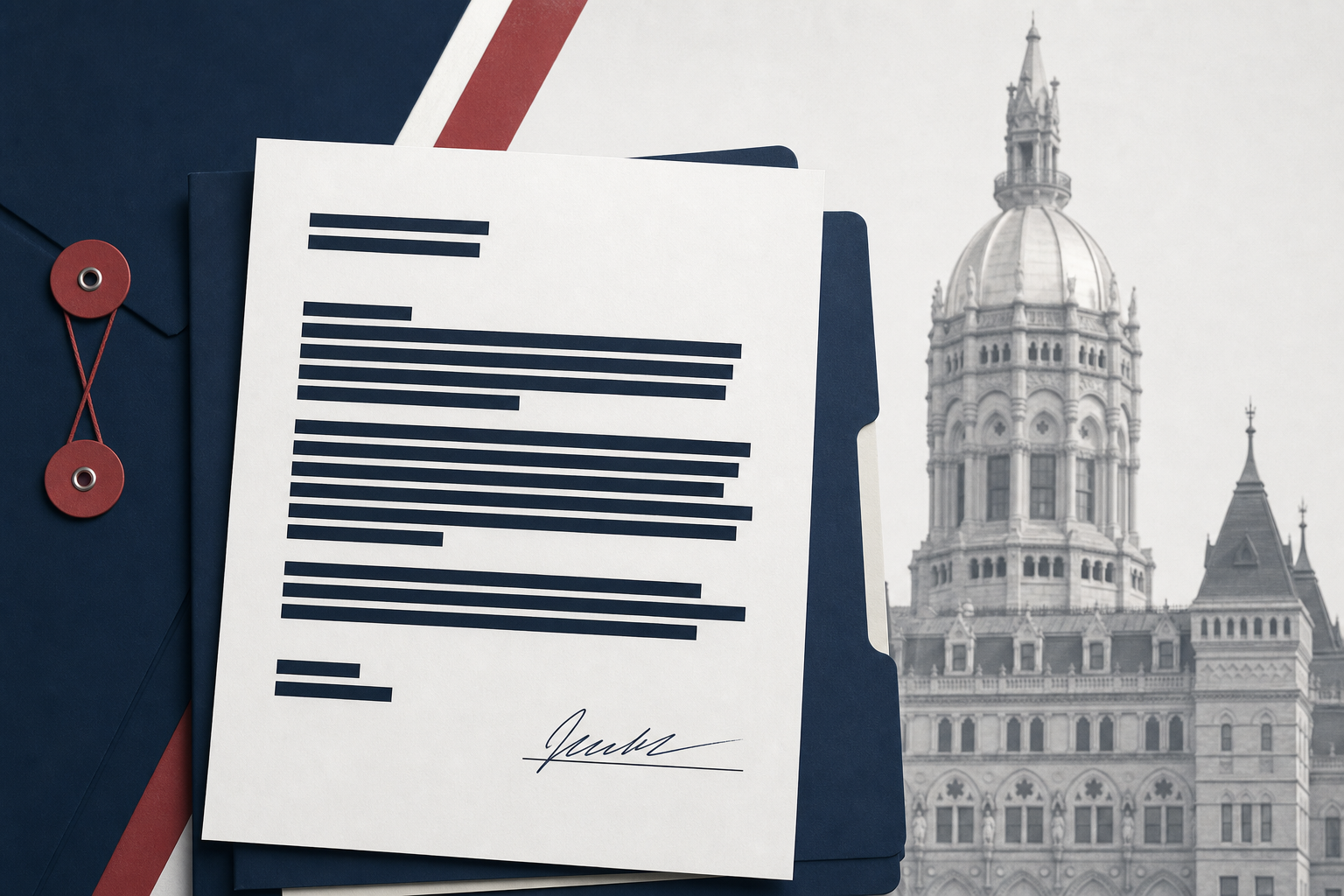
Kirk McConnell’s letter supporting a Connecticut UAP-study bill says senators and staff heard accounts of alleged intelligence collection, crash retrieval and reverse engineering. It does not independently verify those programs.
Kirk McConnell, a former professional staff member to the Senate Armed Services Committee, Senate Select Committee on Intelligence and House Intelligence Committee, has submitted a detailed public account of classified UAP briefings to Connecticut lawmakers.
In a signed March 12 letter supporting H.B. 5422, McConnell wrote that senators and congressional staff heard sources describe alleged executive-branch intelligence collection, crashed-vehicle recovery and reverse-engineering programs involving unidentified anomalous phenomena.
The letter documents McConnell’s description of what lawmakers were told in classified settings; it is not an official confirmation that the alleged programs exist.
McConnell’s account of the briefings
- McConnell identifies himself as a retired federal employee who spent 37 years as a professional staff member on the three committees. He wrote that he began participating with Senate committee colleagues in what he called serious UAP investigations after the New York Times reported in 2017 on classified UAP research.
- Over the next seven years, he said, he attended numerous classified meetings, including meetings attended by senators. Anonymous and publicly known sources, he wrote, provided information he regarded as credible about executive-branch UAP intelligence collection and alleged crash-retrieval and reverse-engineering efforts concealed from Congress and the public.
- McConnell added that some sources claimed direct, first-hand involvement in the activities they described, and that he helped draft Senate legislation intended to increase UAP transparency and accountability.
- A video excerpt circulated by the Disclosure Foundation shows McConnell describing classified meetings in secure facilities attended by senators and staff, and saying speakers were treated as credible. The account in the video broadly follows his written testimony, though neither provides the underlying classified material.
- McConnell’s description is unusually specific about the setting: he says the exchanges took place in classified meetings, inside secure facilities, with senators and committee staff present. That does not reveal what evidence was shown, but it moves the account beyond an anonymous claim and into attributable testimony from a former congressional professional.
- He places those meetings within a longer period of congressional attention following the public emergence of the Pentagon’s earlier UAP work in 2017. In his telling, the issue developed into repeated briefings and legislative work over the following seven years.
The bill that received the letter
McConnell submitted the letter in support of H.B. 5422, An Act Concerning a Study of Unidentified Aerial Phenomena. Connecticut’s official legislative record says the bill received a public hearing on March 12, a joint favorable substitute from the Appropriations Committee on April 1, and was reported out on April 14 as File Number 629 and House Calendar Number 421.
The substitute text would direct the Office of Legislative Management, within available resources, to contract with a science and engineering nonprofit to study unidentified aerial phenomena. The study would consider the benefits and resources for a possible state UAP center and consult relevant public-safety, environmental and military-affairs personnel.
McConnell uses his account of congressional briefings to argue for academic study, improved detection and response arrangements, and greater federal disclosure. The bill record establishes the letter’s legislative setting and procedural status, not the truth of his assertions about federal activity.
The proposed study would not investigate McConnell’s federal allegations. Its practical focus is whether Connecticut should create a state centre able to study reports, coordinate relevant expertise and assess the resources such work would require. That makes the letter part of a policy argument about what a state can do while federal questions remain unresolved.
What remains unverified
- The public record establishes that McConnell made the statements in a signed letter connected to a Connecticut bill.
- The letter does not identify the people who briefed the meetings, the documents they presented, or whether investigators assessed and corroborated their accounts.
- Neither the testimony nor the video excerpt names a purported program or location, or includes contracts, recovered materials, technical data or executive-branch acknowledgement.
- Those gaps prevent independent public verification of the central allegations from the documents and video now public. McConnell’s view that the sources were credible is his reported assessment, not a publicly reviewable evidentiary finding.

Editorial analysis
What the filing adds
The filing places a named former committee staff member’s account of alleged classified-briefing disclosures into a public legislative record. That distinguishes it from anonymous accounts of the same subject, but it does not turn the allegations into established fact.
It also shows that claims about federal UAP oversight are being used to support a proposed state research and preparedness effort. The proposed Connecticut study is not itself a federal investigation.
Attributable witness testimony, declassified records, inspector-general findings, program documentation or an executive-branch response could clarify the particular meetings McConnell describes. No such public corroboration is identified in the letter or video excerpt.
The distinction between testimony and proof should not make the testimony trivial. Classified briefings are not designed for public scrutiny, and a signed account from a former staff member gives the public a concrete statement that can be compared with later records, testimony or official responses.
For now, the strongest new fact is that McConnell has put his name, former roles and account of the briefings into a public legislative record. That creates a clearer line for follow-up: who briefed Congress, what material was presented, and whether any oversight body can corroborate the claims.
Sources
Follow the story
Kevin Campbell Describes Unidentified Objects on MQ-9 Feeds Over East Asia
In a Sept. 3 Americans for Safe Aerospace interview, Campbell said he saw several objects while monitoring military video feeds in 2023–24. A…

Jennice Vilhauer Says ODNI Meeting Covered Plan for Possible NHI Confirmation
In a September 3 post, the UAP Science Advisory Council member described preparedness planning discussed at an August 31 meeting; no plan or…
Post Links Grusch and Elizondo to Roswell-Era Crash Retrieval Claims
Its proposed 70-year narrative relies on purported MJ-12 files, Corso’s accounts and retrospective testimony; the material provides no authenticated records establishing a single…