

Part 2 connects David Grusch’s 2023 testimony and Dylan Borland’s allegations to the model, while the posts offer no direct documentary evidence of recovered non-human technology.
A two-part essay posted to r/UFOs argues that a highly compartmented UAP-related program could, in theory, remain hidden by distributing responsibility across intelligence agencies, military units, classified funding channels, Department of Energy authorities and private contractors. Part 2, posted September 14, shifts from the retrieval-and-custody system proposed in Part 1 to allegations of surveillance, career pressure and retaliation against potential whistleblowers.
The author calls it the “Parallel Control System Hypothesis,” not a demonstrated account of an actual program. The posts offer no direct documentary evidence that established secrecy, technical-recovery and contracting systems have concealed non-human technology.
Part 1 builds a retrieval-and-custody model
- Part 1 starts with historical programs that handled unusual objects and foreign technology, including Air Force Regulation 200-2, Project Moon Dust and Operation Blue Fly. The author argues that the records outline a framework for reporting, evaluating, recovering, transporting and exploiting material of intelligence interest, while acknowledging that they do not prove alien-craft recovery.
- The essay puts allegations by former Marines Jonathan Weygandt and Michael Herrera into that framework. Weygandt has alleged that he encountered an unusual object and unidentified armed personnel in Peru in 1997; Herrera has alleged that his unit encountered a large craft and unidentified armed men during a 2009 deployment to Indonesia.
- The post highlights purported similarities in unmarked personnel, military-style tactics and control of access to a scene. It also notes that both accounts are allegations, Weygandt’s available record is assembled from edited archival material, and other Marines have disputed important elements of Herrera’s account.
- Part 1 then discusses “sheep-dipping,” or temporary reassignment or concealed affiliation, and contractors as ways to limit operational visibility. It says compartmentation and contracting do not remove legal or congressional oversight obligations.
Part 2 centres on retaliation allegations
- The second installment uses David Grusch’s July 2023 House testimony as its reference point for reprisals. It quotes Grusch saying he faced retaliation and knew of planned reprisal activity against himself and colleagues; he declined details at the hearing, citing an open whistleblower-reprisal investigation and classification constraints.
- The essay cautions against reading Grusch’s hearing exchange about murder as confirmation that anyone was killed. It says the official transcript records him declining to answer and that his testimony does not establish the later cases discussed in the post.
- It also recounts former Air Force intelligence specialist Dylan Borland’s allegations of manipulated employment or clearance records, phishing and an attempt to create classification-related jeopardy. No released investigative findings have publicly substantiated those allegations, the post says.
- Borland also described a car crash that he said police privately attributed to cut brake lines, according to the essay. The post says his police report does not record cut brake lines and treats the episode as an unproven allegation, not evidence tying sabotage to an agency, contractor or UAP program.
The official finding alongside the hypothesis
Part 2 places the Department of Defense position alongside the allegations. DoD investigators have said they found no verifiable information supporting claims that the U.S. government possesses or has reverse-engineered extraterrestrial materials. The essay acknowledges that this cuts against its hidden-program proposition, while arguing that it does not settle every individual retaliation allegation.
Editorial analysis
Analysis: capability is not evidence of occurrence
The essay usefully separates capability from occurrence. Governments use classification, compartmentation, specialist technical teams and contractors, making a tightly held program conceivable; the disputed link is whether those tools were used for the alleged UAP activity. Historical records, congressional testimony, interviews and archived testimony can illuminate oversight and whistleblower questions, but carry different evidentiary weight and cannot serve as interchangeable corroboration.
Editorial analysis
Editorial analysis
The immediate development is a more expansive community-built argument, not official confirmation of a crash-retrieval operation or coordinated retaliation system.
It makes its proposed mechanism and source trail available for scrutiny, distinguishing historical records, personal testimony and inference.
Sources
Follow the story
Former Congressional Staffer Details UAP Briefing Claims in Connecticut Testimony
Kirk McConnell’s letter supporting a Connecticut UAP-study bill says senators and staff heard accounts of alleged intelligence collection, crash retrieval and reverse engineering.…
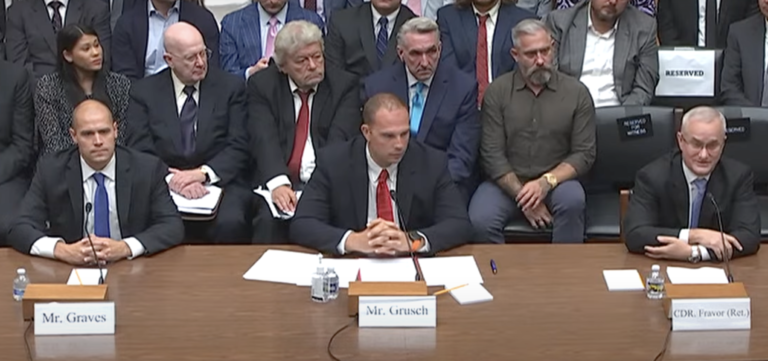
Grusch offers Trump an ‘A-team’ to track down alleged UAP holdings
In an August interview now being recirculated, he described the people he could call, the facilities he would pursue and the risk of…
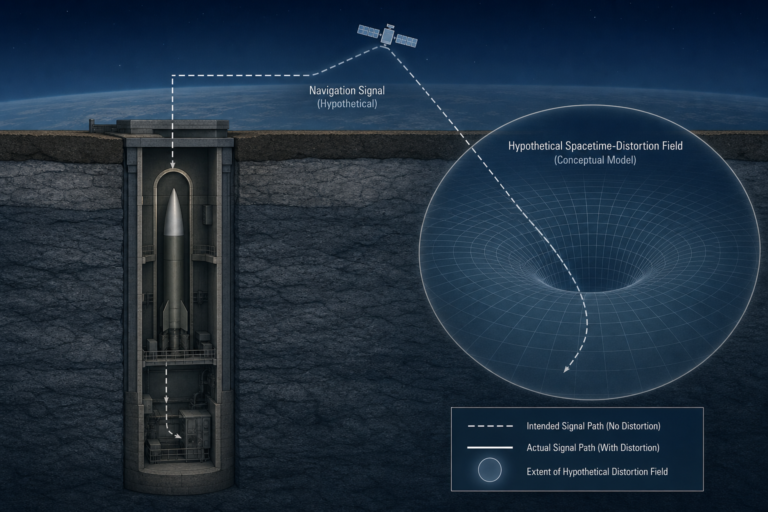
Kevin Knuth Says Space-Time Distortion Could Explain Malmstrom Missile Failures
In a September 9 NewsNation interview, the physicist proposed that a disturbance in space-time could disrupt missile navigation; the report also cites a…