

The XPRIZE founder points to public testimony and institutional interest, but says he has no firsthand experience; his essay presents a case for investigation rather than independently verified proof of non-human intelligence.
XPRIZE founder Peter H. Diamandis has called for scientific attention to reports of unidentified anomalous phenomena, or UAPs. In a 7 September essay, he wrote that he has no firsthand experience of UAPs or non-human intelligence, but said what he considers mounting evidence had drawn his attention.
Testimony, data and institutional attention
Diamandis points to public accounts from former government and Defense Department personnel, including witnesses who have described alleged UAP programmes or encounters. He says those accounts are a reason to take the subject seriously.
He cites UAP-related work and discussion involving NASA, Harvard astrophysicist Avi Loeb’s Galileo Project and the UAP Science Advisory Council. In his telling, anomalous reports can be investigated through instruments, data collection and scientific scrutiny.
Diamandis frames his position as an alternative to a believer-versus-sceptic argument, writing: “I am not asking you to believe. I am asking you to look.”

A hypothesis about nuclear sites and AI
The essay also discusses reported UAP activity near nuclear facilities. Diamandis speculates that hypothetical non-human observers might be interested in technologies that could alter civilisation’s trajectory, including nuclear weapons and advanced artificial intelligence.
He presents that proposed connection as a hypothesis and acknowledges that correlation does not establish causation.
What the essay leaves unresolved
Diamandis’s essay establishes his public position, not the underlying claims it discusses. The cited material does not independently verify whistleblower allegations, reported incidents or the existence of non-human intelligence, nor does it provide independently assessed evidence to determine whether separate reports have one external cause, ordinary explanations, misidentification or multiple unrelated causes.
Editorial analysis
Why his distinction matters
Diamandis advances a narrower proposition than the broader conclusions often attached to UAP reports: anomalous accounts can justify disciplined collection and evaluation while their origin remains unsettled. Stronger conclusions would require transparent, high-quality material that independent researchers can examine, rather than testimony or patterns alone.
Editorial analysis
Editorial analysis
The essay, titled “The Evidence Around UAPs Is Getting Harder to Ignore,” argues for examining reports and testimony rather than claiming that any particular explanation has been established.
The argument concerns research priorities and how reports are interpreted; it is not evidence that a non-human presence is monitoring nuclear sites or AI development.
XPRIZE’s description corroborates Diamandis’s role at the organisation, but does not corroborate the UAP-related assertions in his essay.
Sources
Follow the story
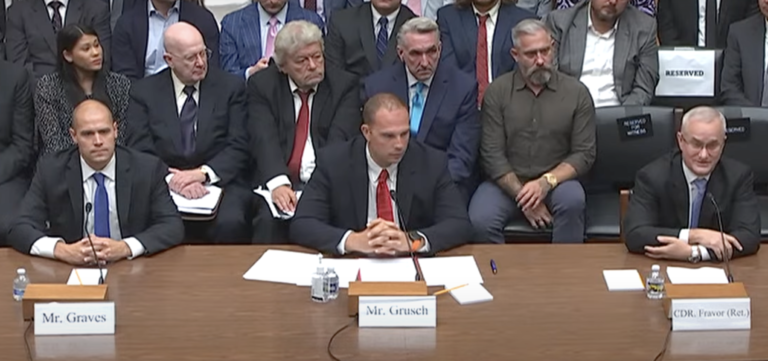
Grusch offers Trump an ‘A-team’ to track down alleged UAP holdings
In an August interview now being recirculated, he described the people he could call, the facilities he would pursue and the risk of…

Two-part r/UFOs essay proposes a “Parallel Control System” for a hidden UAP program
Part 2 connects David Grusch’s 2023 testimony and Dylan Borland’s allegations to the model, while the posts offer no direct documentary evidence of…

Kevin Knuth Says Space-Time Distortion Could Explain Malmstrom Missile Failures
In a September 9 NewsNation interview, the physicist proposed that a disturbance in space-time could disrupt missile navigation; the report also cites a…