
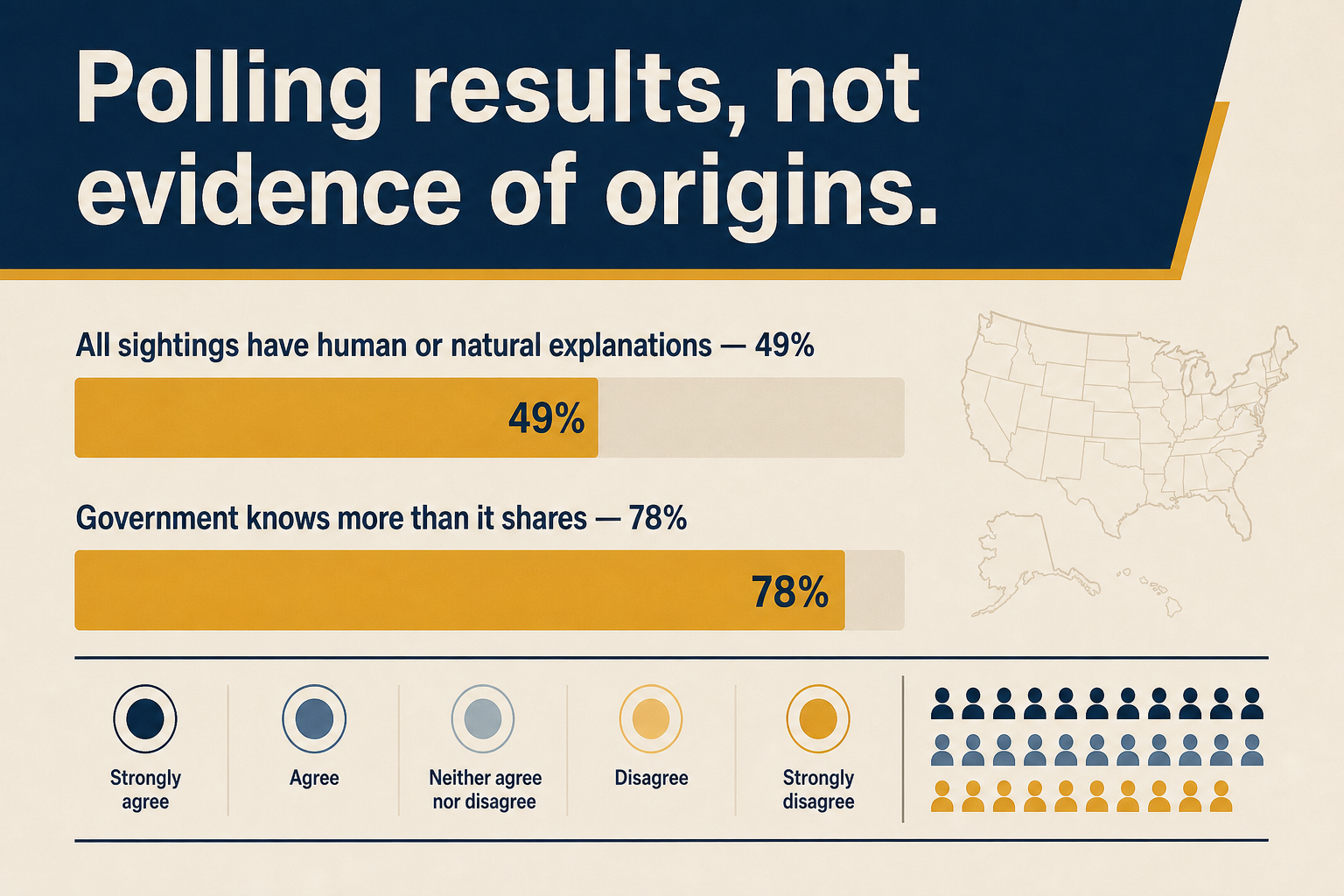
The poll also found 49% of U.S. adults favor human or natural explanations for all sightings, while 37% say at least some are extraterrestrial; it measures public belief, not what any sighting was.
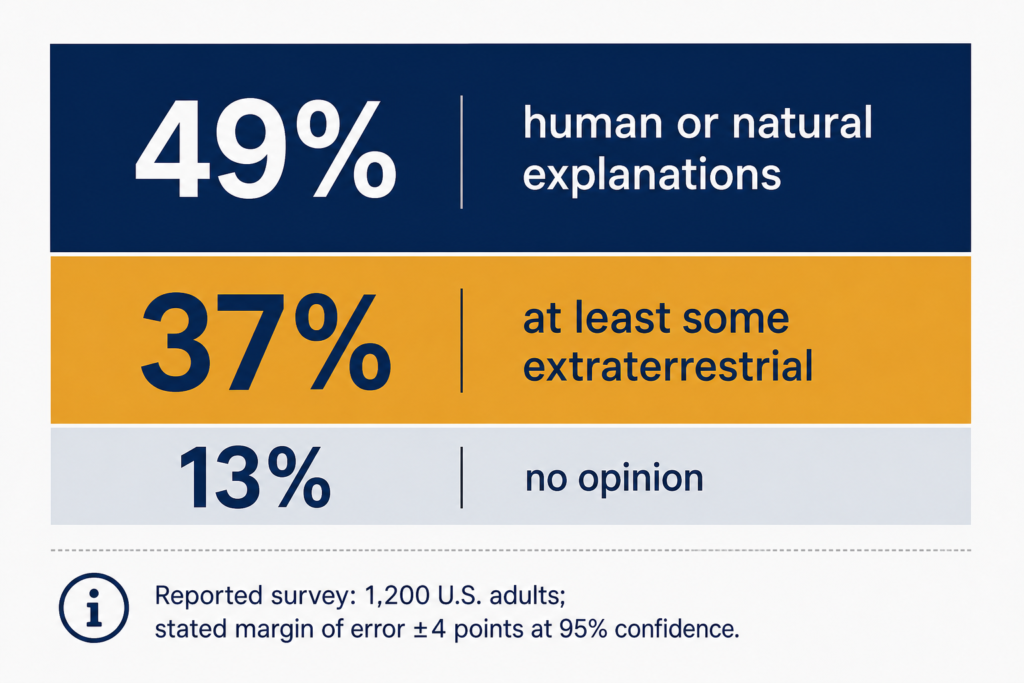
A Gallup poll reported by The Hill and NewsNation found that 49% of U.S. adults think all UFO sightings can be explained by human activity or natural phenomena. Thirty-seven percent said at least some UFOs are extraterrestrial, and 13% offered no opinion.
The same reporting found a much larger share, 78%, saying the U.S. government knows more about UFOs than it tells the public; 17% said it is not withholding information. The poll measures beliefs about possible explanations and official transparency, not the origins of any particular sighting.
A plurality favors ordinary explanations
- The 49% who chose human or natural explanations formed the poll’s largest group, but not a majority. More than one-third endorsed an extraterrestrial explanation for at least some sightings.
- The reported skeptical share was 60% in 2019, 50% in 2021 and 49% in 2026. Over the same period, the share with no opinion rose from 7% to 13%.
- Those figures do not, by themselves, show a comparable move toward an extraterrestrial conclusion. Part of the decline in skepticism coincides with a larger undecided group.
Reported sightings correlate with stronger alien belief
More than four in five Americans had heard or read about UFOs, according to the reporting, while 17% said they had seen something they considered a UFO. Among respondents who said they had seen something unexplained in the sky, 61% said some UFOs are alien in nature.
Men, adults aged 18 to 29 and college graduates were reported to be more skeptical than women, older adults and those without a college degree. Belief that the government withholds information was broadly consistent across demographic groups, including political affiliation.
A respondent’s view that an object was unexplained does not establish what it was. The survey records perceptions and experiences rather than offering a scientific assessment of individual sightings.
What the poll can and cannot show
The Hill reported that Gallup surveyed 1,200 U.S. adults from July 1 through July 19, with a stated sampling margin of error of plus or minus 4 percentage points at the 95% confidence level. A one-point difference between the reported 2021 and 2026 skeptical shares should therefore not be treated as a precise one-point change across the country.
The published accounts cited here do not include the questionnaire, question order, weighting details or demographic crosstab tables. That leaves the effect of wording and the scale of subgroup differences impossible to independently assess from these reports.
The poll also cannot establish that the government has withheld UFO information. It measures what respondents believe, rather than what government records or agencies can substantiate.
Editorial analysis
Analysis: distrust and alien belief are not the same measure
The reported figures show that belief in government secrecy reaches far beyond belief in extraterrestrial origins: 78% versus 37%. Those views can coexist without contradiction, since respondents may suspect classified activity, incomplete investigations or official opacity while still favoring ordinary explanations for sightings.
The survey does not show which reasons respondents had in mind. Publication of Gallup’s questionnaire and tabulations would allow a closer reading of how people interpreted terms such as “UFOs,” “extraterrestrial visitors” and government knowledge.
Sources
Related coverage
- Roscommon Herald Reports RTÉ Documentary on Boyle Lights and Lough Key Experiment
- DeFi Rate puts odds of qualifying U.S. extraterrestrial declaration by 2026 at 4.5%
- Recovered World Cup guide offers no evidence for ‘Ufo Files’ title
- Space Daily says Mars, K2-18 b and UAP evidence remains unconfirmed
- USA Herald calls for wider testing of reported luminous UAP lights
Follow the story

Kevin Campbell Describes Unidentified Objects on MQ-9 Feeds Over East Asia
In a Sept. 3 Americans for Safe Aerospace interview, Campbell said he saw several objects while monitoring military video feeds in 2023–24. A…

Jesse Michels’ Team Says It Found a Second Witness to Mario Woods’ 1977 UFO Account
A Reddit post identifies the man as Michael Johnson and says a video interview is due this week. The available material does not…