
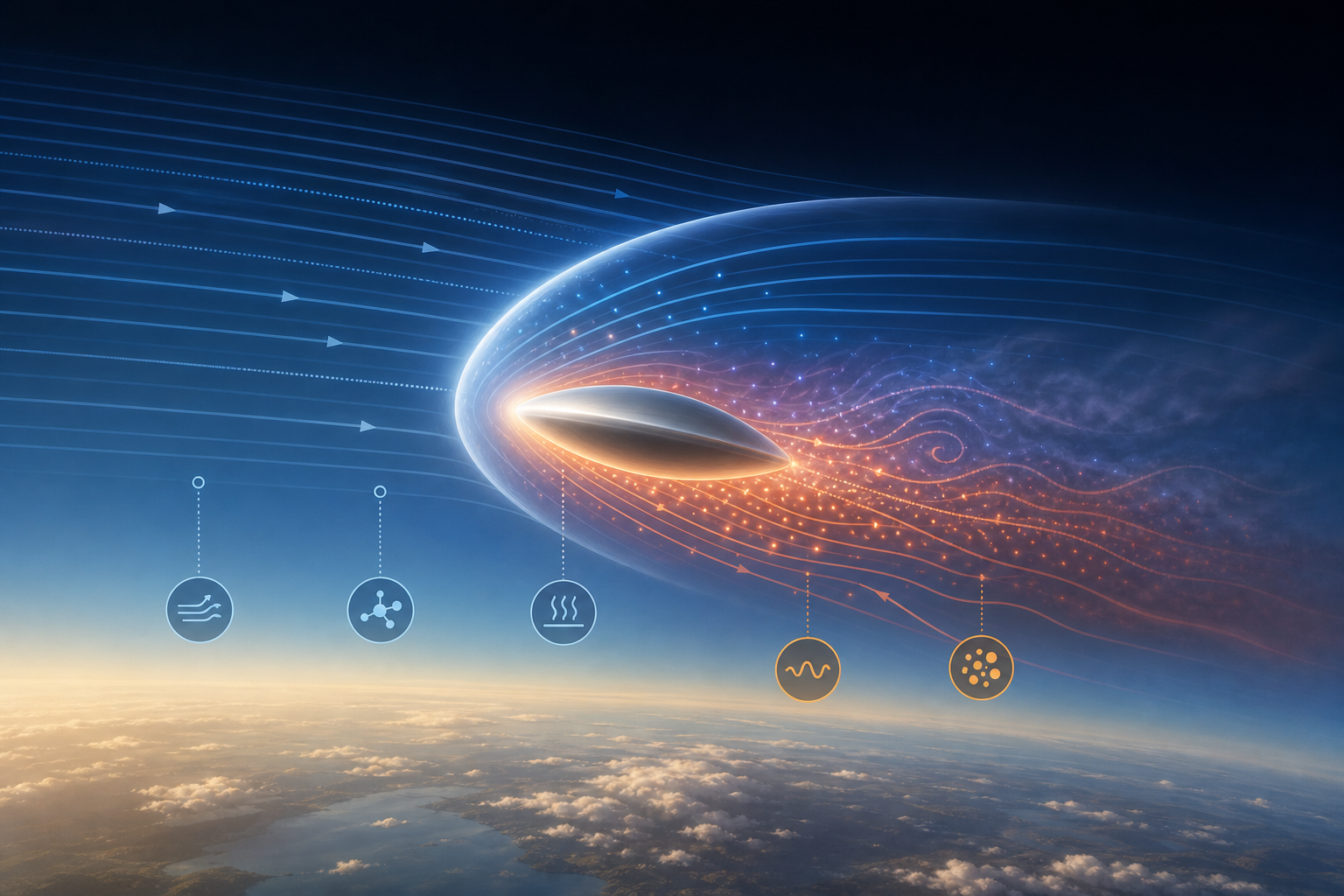
Shaun Fell and Abraham Loeb calculate that an aircraft-scale spacetime bubble moving through air above roughly one-tenth of light speed would produce an enormous radiative signature. The paper is a theoretical preprint, not evidence that any UAP uses a warp drive.
The Story
A new physics preprint asks a practical question about one of science fiction’s most famous ideas: if a warp drive crossed Earth’s atmosphere at relativistic speed, what would observers actually see?
Shaun David Brocus Fell and Abraham Loeb conclude that it would be difficult to miss. Their simulations predict that an aircraft-scale warp bubble moving faster than about ten percent of light speed would generate a brilliant atmospheric glow, with luminosity exceeding one terawatt in the regimes highlighted by the paper.
The result offers an observational constraint on hypothetical spacetime propulsion. It does not show that warp drives exist, that one has entered the atmosphere or that a luminous UAP was produced by such a system.
What We Know
Fell and Loeb submitted “Radiative Signatures from Warp Drives Traveling Through the Earth’s Atmosphere” to arXiv on August 11, 2026. The publicly available version is a preprint and had not completed journal peer review when checked on August 28.
The paper models zero-ADM-mass warp-drive spacetimes moving through Earth’s atmosphere. ADM mass is a way physicists describe the total mass-energy of a spacetime as measured from far away; “zero ADM mass” is a property of the theoretical geometry, not a claim that a real craft has been built.
The authors use numerical simulations to examine how atmospheric gas would behave around the bubble. At high speed, compressed gas forms an energetic shock and produces strong radiation. The predicted output rises sharply with bubble size and velocity.
The abstract says an aircraft-scale bubble travelling above approximately 0.1 times the speed of light would produce a distinctive brilliant glow. A bubble at rest or moving slowly relative to Earth would not create the same extreme luminosity through this mechanism.
What Is Being Claimed
The authors argue that their calculations can place observational limits on spacetime-based propulsion operating near Earth. A sufficiently large, fast bubble should have a radiative signature that telescopes, satellites or other sensors could search for.
In interviews reported by The Debrief, Fell and Loeb connected the model with discussion of bright or orb-like UAP reports. That is a proposed line of inquiry, not a match between the simulation and a documented event.
The paper does not identify a particular Pentagon release, establish the distance or speed of a reported object, or demonstrate that any observation satisfies the model’s conditions.
The Evidence
The primary evidence is the arXiv manuscript itself. Its title, authors, submission date, abstract and model are publicly available, allowing specialists to inspect the assumptions and calculations rather than relying only on an interview about the work.
The Debrief adds comments from the researchers and explains why they see a possible UAP application. Those comments help establish the authors’ interpretation, but the technical claims stand or fall with the preprint and subsequent scrutiny.
No event-level sensor package accompanies the paper. There is no calibrated UAP observation in the article that can be compared with the predicted brightness, spectrum, velocity and atmospheric conditions.
- Radiative Signatures from Warp Drives Traveling Through the Earth’s Atmosphere arXiv preprint by Shaun David Brocus Fell and Abraham Loeb
- Physicists Reveal Possible Connection Between “Warp Drive” Spacecraft and Pentagon Releases The Debrief
What We Don’t Know
The model has not yet passed peer review or independent replication. Its conclusions may change as specialists test the numerical assumptions, radiation treatment and chosen spacetime geometry.
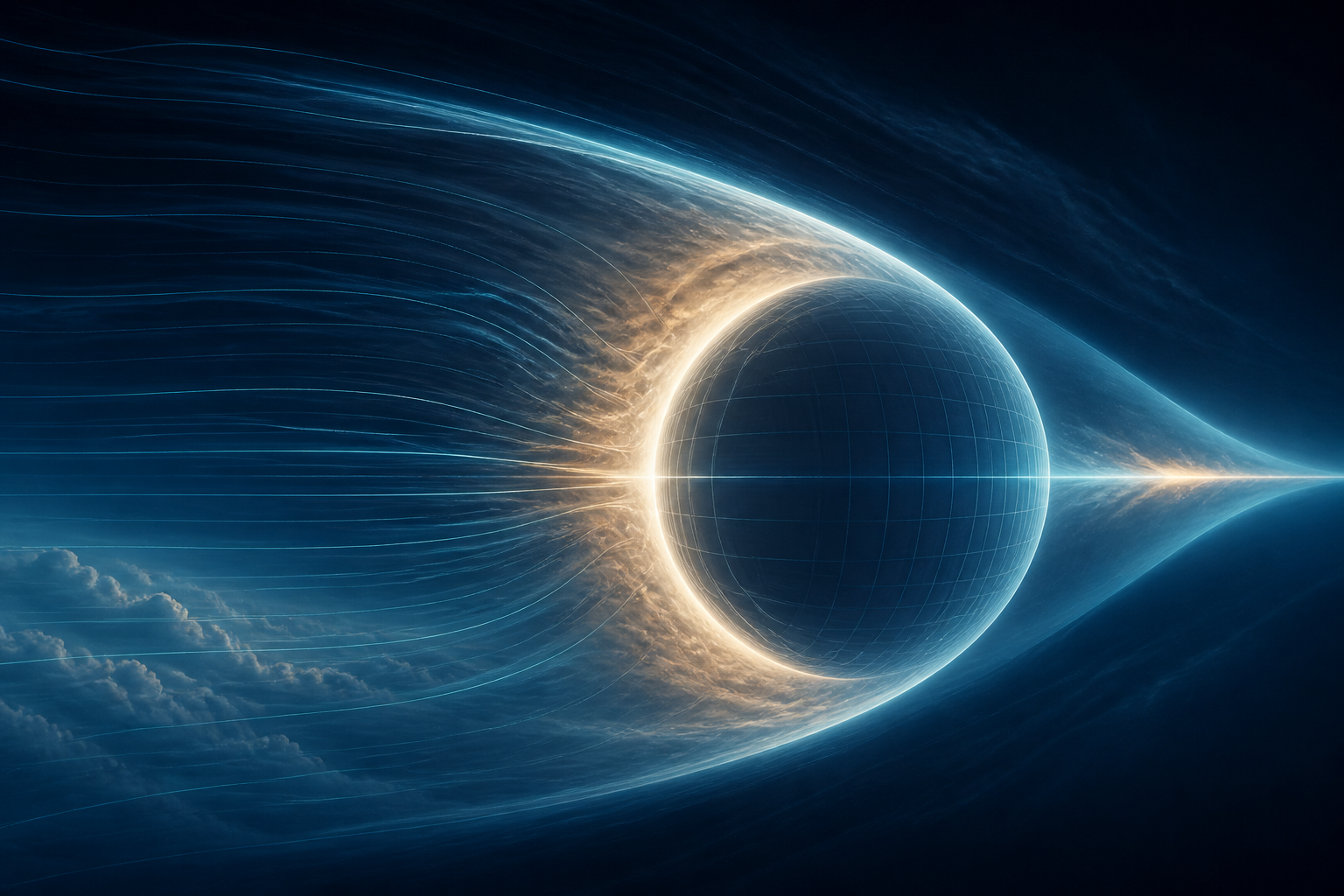
The paper does not establish whether a physically achievable warp bubble can be created, controlled or moved through the atmosphere. A mathematically modelled spacetime is not an engineering design.
No public UAP case cited in the reporting supplies all the measurements needed for a direct comparison. Without calibrated brightness, spectrum, distance, velocity and atmospheric context, an apparent light or orb cannot be tested against the predicted signature.
The simulations also leave open other regimes, including small bubbles and much lower speeds that would not produce the same shock-driven glow.
Why This Matters
Speculative ideas become scientifically useful when they produce consequences that can be measured or ruled out. Fell and Loeb’s work moves the discussion from “could warp drives explain UAP?” toward a sharper question: where is the radiation that a large, fast atmospheric bubble should create?
That is relevant to UAP research even if the answer is negative. A case lacking the predicted luminosity would not fit this particular high-speed, aircraft-scale model, while a claimed match would require far better data than a distant point of light.
Editorial analysis
Our Analysis
The paper is more useful as a constraint than as an explanation. It suggests that a relativistic craft wrapped in the modelled spacetime would announce itself through an extreme atmospheric interaction rather than pass quietly as an ambiguous light.
That creates a demanding standard for future claims. Researchers would need calibrated observations and enough context to test the predicted spectrum, luminosity and speed. Until such a comparison exists, attaching the phrase “warp bubble” to a UAP video adds drama but not evidence.
The slower and smaller regimes are the obvious next question. If those configurations avoid the brilliant signature, future work must specify what they would produce and whether any instrument could distinguish them from ordinary atmospheric or technological sources.
Alternative Explanations
- Atmospheric or astronomical sources — Meteors, plasma, stars and other luminous phenomena can appear unusual without requiring exotic propulsion.
- Aircraft, drones or satellites — Position, motion and sensor geometry can make conventional objects appear orb-like, especially in short or poorly contextualised clips.
- Sensor and processing effects — Blooming, glare, focus, compression and infrared display choices can change apparent shape and brightness.
- Insufficient data — The preprint contains no case-level dataset, so no conventional or exotic explanation can be ranked for a specific UAP from this work alone.
Primary Sources
- Fell and Loeb — Radiative Signatures from Warp Drives Traveling Through the Earth’s Atmosphere
arXiv:2608.10800 · submitted August 11, 2026 · preprint checked August 28, 2026 - The Debrief — interview and report on the preprint
Secondary reporting and author comments · checked August 28, 2026
Follow the story

Peter Diamandis Publishes Essay Calling for Scientific UAP Research
The XPRIZE founder points to public testimony and institutional interest, but says he has no firsthand experience; his essay presents a case for…
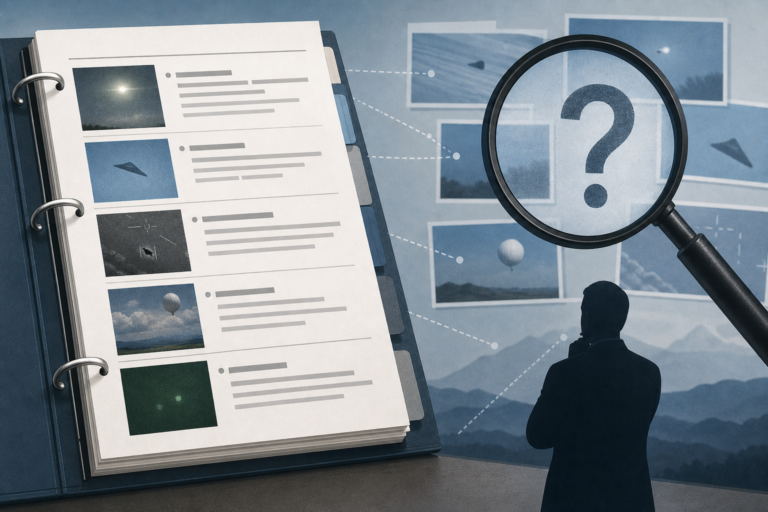
AARO’s UAP Library Links New Military Case Videos and Reports
A U.S. government AARO webpage lists dozens of report documents released May 8 and a later set of UAP imagery entries, but the…