
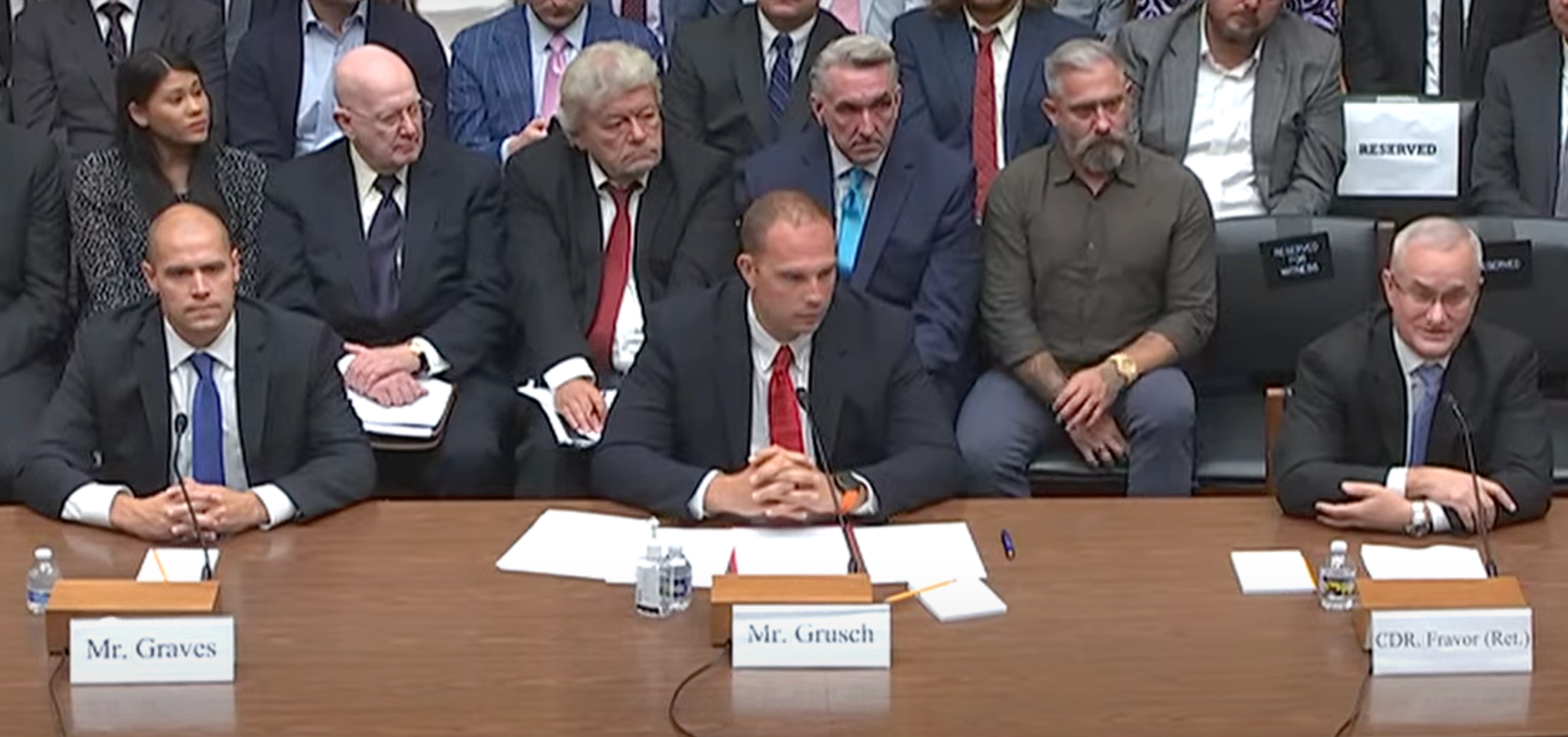
In a Sept. 4 WEAPONIZED clip, the hosts also allege that CIA intervention blocked a proposed transfer from Lockheed to a Robert Bigelow-linked AAWSAP effort; the discussion provides no documentary or physical verification.
Jeremy Corbell and George Knapp have renewed an allegation that Lockheed Martin considered transferring purported recovered material to an effort connected with Robert Bigelow and the Pentagon-backed Advanced Aerospace Weapon System Applications Program, or AAWSAP. In a WEAPONIZED clip published September 4 from a September 2 episode, the hosts said CIA intervention stopped the proposed exchange and raised the question of where the purported material went.
The discussion offers a current account of alleged location information and claimed contact with federal agencies, not documentation of a new recovery or transfer. The clip shows no agreement, chain-of-custody record, independently examinable sample or government inspection finding. It establishes that Corbell and Knapp made the claims, not that the material exists, was transferred or had a non-human origin.
What Corbell and Knapp say happened
Corbell and Knapp said Bigelow had authorised them to discuss alleged negotiations involving Lockheed and an intended transfer of material to Bigelow’s organisation in connection with AAWSAP. They said people involved in, or aware of, those discussions had supplied further detail since the allegation first circulated. The hosts described the subject as purported crash remnants, not a complete craft.
They alleged that CIA intervention halted the prospective arrangement. No contemporaneous CIA record, Lockheed document or executed agreement is shown in the clip, leaving the alleged intervention as the hosts’ account of what they were told.
The pair also returned to a Southern California office complex that one host said they had filmed years earlier. The host said it no longer appeared to be a Lockheed building and treated it as part of a historical location trail, not a verified present-day storage site. Corbell and Knapp suggested the purported material might have been moved, but the clip provides neither a verifiable address nor a documented chain of custody.
Later, the hosts said the Office of the Director of National Intelligence and other federal agencies had asked them to help locate purported material. They said precise location information should go to Congress so investigators could inspect relevant sites. The clip displays no agency request, correspondence, congressional referral or inspection report; the claim is not confirmation by ODNI or another agency that material exists or that an inspection occurred.
An older allegation and a separate official record
- A publicly available historical document describes a broadly similar alleged proposal to move material from Lockheed to an AAWSAP-related effort, with alleged CIA opposition. Its public-release marking is dated September 2023, showing the central transfer allegation circulated before this week’s WEAPONIZED discussion. The document says its views are not official United States government policy.
- Its release does not validate the substantive allegations or independently prove a transfer, recovery or the claimed nature of any material. It may draw on witnesses or accounts overlapping with those discussed by Corbell and Knapp, limiting its value as separate corroboration. The new clip’s distinction is the hosts’ emphasis on an alleged location trail and their call for records or site access, rather than a physical exhibit.
- AARO’s published history of KONA BLUE describes it as a proposed Department of Homeland Security special-access program that followed AAWSAP. According to AARO, KONA BLUE was terminated and no material or data was transferred to DHS under that proposal. That account addresses KONA BLUE’s proposed scope; it does not independently substantiate the Lockheed-transfer allegation or resolve claims about other alleged programmes or holdings.
Editorial analysis
From testimony to an oversight question
The consequential part of the new account is the claim that actionable location information exists and should reach congressional investigators. A dated agency request, documentary transfer trail, site-access records or an inspection result could make that claim testable as an oversight matter. None is presented in the clip.
The unanswered questions are whether the proposed transfer was formally documented, whether agencies sought assistance as described, which entity held the alleged remnants at any relevant time, and whether material can be independently examined. Until records or physical evidence emerge, the episode remains a renewed, attributed account of a longstanding allegation rather than confirmation of the underlying claim.
Sources
Follow the story
Kevin Campbell Describes Unidentified Objects on MQ-9 Feeds Over East Asia
In a Sept. 3 Americans for Safe Aerospace interview, Campbell said he saw several objects while monitoring military video feeds in 2023–24. A…
Reported Gallup Poll Finds 78% Think U.S. Withholds UFO Information
The poll also found 49% of U.S. adults favor human or natural explanations for all sightings, while 37% say at least some are…

Jesse Michels’ Team Says It Found a Second Witness to Mario Woods’ 1977 UFO Account
A Reddit post identifies the man as Michael Johnson and says a video interview is due this week. The available material does not…